Energy Update



A Fairytale of Energy Independence
-
 Pawan Bhatta
- 23 April, 2026
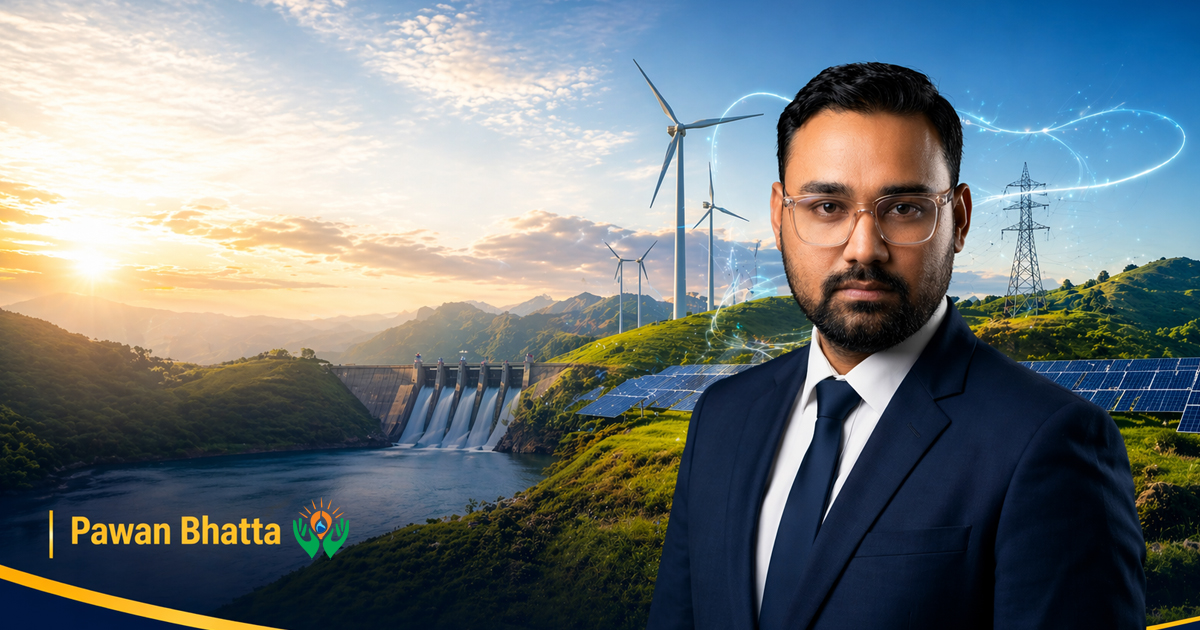
Nepal has an estimated 42,000 MW of economically viable hydropower potential. And yet, every winter, the lights flicker and industries throttle back. The country that could be South Asia’s renewable powerhouse finds itself importing electricity from a neighbour it could, theoretically, be supplying.
The reason is not a lack of water. It is a lack of memory, the power system’s inability to remember the monsoon when the mountains run dry. That memory, in engineering terms, is called storage. And in Nepal, it remains critically underdeveloped. Nepal’s seasonal paradox is not a failure of nature. It is a failure of infrastructure policy.

Nepal’s power demand is growing at nearly 10 per cent per year. Cross-border power trade with India and Bangladesh is expanding. Electrification targets are ambitious, covering transport, cooking, and industry. Yet the generation-first mindset that has dominated Nepal’s energy planning for decades is no longer sufficient. MW must be matched with megawatt-hours, electricity available not just when rivers flow, but when industries open and cities wake.
The seasonal arithmetic is stark. During the monsoon, run-of-river plants generate far more power than the grid can absorb. During the dry season, output collapses and Nepal turns to imports. Without large-scale storage, this cycle will repeat indefinitely, growing more expensive and more precarious as demand increases.
Nepal Electricity Authority (NEA) made headlines when it called for proposals for roughly 960 MW of new grid-connected solar capacity, the largest such procurement the utility has ever attempted. The tender, which saw the previous 800 MW round oversubscribed by developers offering a combined 3.6 gigawatts of capacity, drew bids at tariffs as low as NPR 5.38 per kilowatt-hour, roughly three and a half US cents. For context, that is cheap by any regional standard.
The instinct to cheer is understandable. Solar is fast to build, getting cheaper every year, and Nepal’s plains and mid-hills receive abundant sunlight. The government has already planned to scrap the old 10 per cent cap on solar in the national energy mix and is pushing toward a target of 15 per cent. Newer approvals, including utility-scale projects in Saptari and Siraha, are the first in the country to include a 30 MW battery energy storage system as an integrated component. Something, evidently, is shifting.
But here is the uncomfortable question that the procurement documents do not answer: where does the solar power go when the sun is shining and nobody needs it? We don't have a flat load curve. Nepal’s peak loads occur in the morning and evening. Solar peaks around midday. Without the infrastructure to shift that midday surplus, into batteries, into pumped hydro reservoirs, or across interconnectors, Nepal risks building 960 MW of generation capacity that cannot reliably serve the load it was meant to serve.
That is not a reason to stop building solar. It is a reason to build storage at the same pace. There is another dimension to this story. India has been building solar capacity at a pace that is, frankly, staggering. As of 2026, the country has projected well over 141 GW of installed solar and is adding tens of gigawatts more each year. The result, increasingly, is a midday surplus problem of its own.
On sunny afternoons, the Indian grid is oversupplied with cheap solar electricity. Prices on the Indian Energy Exchange during these off-peak hours can collapse to near zero. Grid operators have, on multiple occasions, struggled to find buyers for surplus power.
Nepal’s existing interconnection with India, primarily through the 400 kV Dhalkebar–Muzaffarpur line, with the New Butwal–Gorakhpur corridor under construction, already enables cross-border power flows in both directions. The logic here is almost elegant in its simplicity: Nepal could import India’s midday solar surplus at very low cost, use that energy to pump water uphill into pumped hydro reservoirs, and then generate firm, dispatchable power during evening peaks when India itself is desperate for electricity and will pay a premium.
This is not a theoretical arbitrage. Switzerland does exactly this with Europe, buying cheap overnight nuclear and midday solar from France and Germany, storing it in Alpine reservoirs, and selling peak power back at three to four times the purchase price. Nepal has better geography for pumped hydro than Switzerland. The cross-border interconnection infrastructure, while still growing, is moving in the right direction. What is missing is the regulatory framework to enable dynamic, price-responsive energy trading, and of course, the pumped hydro capacity to store what is imported. India’s midday solar surplus is not a problem for Nepal. It is a subsidy waiting to be claimed.
Pumped Hydro works on a simple principle: pump water uphill when power is cheap or plentiful, release it through turbines when it is needed. It is, in essence, a mountain-sized rechargeable battery, and Nepal’s terrain practically designed for it.
The country’s steep river valleys, high elevation differentials, and dense hydraulic networks make it one of the most geographically favoured nations on earth for pumped hydro. Nepal has been estimated to have over 2,800 potential pumped hydro sites, with a combined storage capacity exceeding 50 terawatt-hours.
The advantages go beyond scale. A well-built pumped hydro plant operates for 50 to 100 years with minimal performance degradation. It provides grid inertia, frequency regulation, and black-start capability, services that batteries struggle to replicate at the system level. And crucially, when paired with India’s daytime solar imports, it becomes a net revenue generator rather than just a cost centre: buy cheap, store, sell.
Development timelines span decades from survey to commissioning. Nepal’s Himalayan geology demands rigorous seismic and landslide engineering.
The obstacles are real and should not be ignored. Capital costs run to one and a half to three billion US dollars per GW. Development timelines span decades from survey to commissioning. Nepal’s Himalayan geology demands rigorous seismic and landslide engineering. Environmental safeguards, around river flows, upstream communities, and biodiversity, cannot be treated as bureaucratic formalities. But these are solvable problems. They are challenges of execution, not of concept.
The recent decision of the NEA to carry forward the 100 MW Kulekhani - Sisneri Pumped Hydro Project is a step that should be recognized as a critical pivot toward ensuring long-term grid stability and reducing Nepal’s seasonal dependency on electricity imports from India.
Battery Energy Storage Systems (BESS) are, in a sense, the connective tissue between Nepal’s solar ambitions and its pumped hydro future. They cannot replace pumped hydro for seasonal balancing, no chemistry yet can store energy economically for weeks at a time, but they can do things pumped hydro cannot: respond to grid disturbances in milliseconds, firm up solar output hour by hour.
Nepal’s emerging solar projects are beginning to recognise this. The 55 MW Saptari and 77.75 MW Siraha solar projects, both recently approved with integrated 30 MW BESS components, are the country’s first concrete acknowledgment that solar without storage is an incomplete answer. These are small steps, but they are the right direction.
In Nepal’s context, BESS serves three distinct purposes that no other technology covers as well. First, it firms up the solar output from NEA’s 960 MW procurement, smoothing the midday ramp, extending dispatch into the evening peak, and preventing the curtailment that would otherwise make those cheap tariffs worthless. Second, it provides frequency regulation and voltage support across a grid that is increasingly integrating variable generation. Third, in hill and mountain communities where grid extension is expensive or climatically fragile, solar plus BESS microgrids can deliver reliable electricity without waiting for transmission lines that may take decades to arrive.
Nepal does not need to choose between these technologies. It needs both, deployed in a layered architecture: pumped hydro as the backbone for seasonal balancing and grid inertia; BESS as the nervous system for rapid response and solar firming; and smart grid infrastructure real-time forecasting, energy management systems, demand response, as the connective tissue that makes them work together.
The geography is favourable. The economic rationale is clear. What is missing is policy architecture and execution discipline.
NEA’s solar procurement is a genuine step forward, but it needs to be accompanied by a parallel storage mandate. Every large solar project above a certain threshold should include either an integrated BESS component or a contractual obligation to contribute to grid-level storage procurement. The Saptari and Siraha precedent exists, it needs to become the rule, not the exception.
Nepal also needs a regulatory framework that treats imported cheap solar from India not as a threat to domestic generators, but as a raw material for pumped hydro production.
Nepal also needs a regulatory framework that treats imported cheap solar from India not as a threat to domestic generators, but as a raw material for pumped hydro production. This means dynamic trading agreements, real-time price signals, and transmission scheduling that allows Nepal to act as a price-responsive buyer during off-peak hours and a premium seller during peaks. It means, in short, treating the grid as a trading platform, not just a delivery system.
Multilateral development finance institutions, the World Bank, the Asian Development Bank (ADB), the Asian Infrastructure Investment Bank (AIIB), have the instruments to reduce project risk and lower the cost of capital for pumped hydro development. Nepal should be drawing on all of them, while building the domestic regulatory and institutional capacity to deploy that capital wisely. Energy independence is not a slogan. It is a system condition, achieved megawatt-hour by megawatt-hour, decision by decision.
Every dry season without adequate storage is a levy on Nepal’s economy. Every megawatt-hour imported at peak prices consumed in a Kathmandu hotel or a Simara factory is a symptom of a structural failure that has been tolerated far too long.
Nepal’s 960 MW solar push is encouraging. The fact that developers were willing to bid at low tariffs per kilowatt-hour tells us everything about where solar economics are headed. But generation without storage is a half-built house. The roof keeps the rain out. The foundation holds the walls up. Storage is the foundation.
The mountains are there. The rivers are there. India’s midday solar surplus is there, cheap and abundant and going to waste on the other side of an interconnector that Nepal is not yet using to its full advantage. What Nepal needs now is the decision to treat storage, pumped hydro for the long game, BESS for the short, not as an engineering detail, but as a strategic national priority, as fundamental to energy sovereignty as the dams themselves.
Bhatta is an Electrical Engineer at the Nepal Electricity Authority, holding an M.Sc. in Power System Engineering and an MBA.
Conversation
Pawan Bhatta
Pawan Bhatta B.E. (Electrical), MBA, Electrical Engineer, Nepal Electricity Authority and currently M.Sc. Candidate, Power System Engineering, IOE, Pulchowk Campus

More News



- Nepal's First Energy Based News Portal
-
Energy Information Center Pvt. Ltd.
Hemant Marg-11, Babar Mahal, Kathmandu
- Info. Dept. Reg. No. : 254/073/74
- Telephone : +977-1-5321303
- Email : [email protected]