Energy Update



Karnali’s Regional Power Grid: Strategic Engineering & Technical Realities
-
 Er. Sadam Bala
- 9 September, 2026
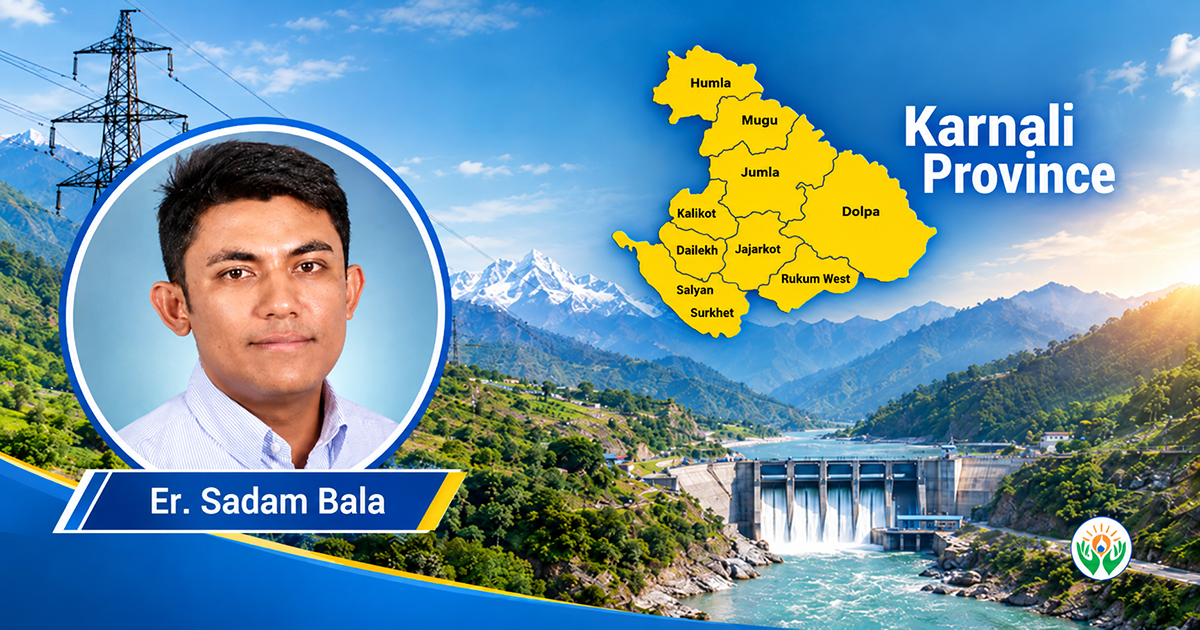
For a power system engineer, a grid is not just a diagram on a screen or towers, wires and transformers in the field. It is something tangible. Even more, if you are analyzing a long radial feeder reaching a remote settlement, the realization that every kilometer of conductor, every transformer, every demand of power and every unit of energy is part of one living system becomes more vivid. A change or disturbance at one point could be readily sensed at the rest of the network.
It is very exciting to discuss about how many megawatts Nepal can produce; how many hydropower projects are under construction and how much electricity can be exported. While sparks of delight follow through the success stories about the expanding generation capacity, transmission infrastructure and the distribution network reaching every district, it is equally important to take into account challenges ahead.

If Nepal has so much electricity, why are there still so many complaints about its reliability? Why isn’t this progress reflected in every part of the country? Is there an issue with data, its analysis or its interpretation? Advancement at the national level does not necessarily guarantee that each region within the country will have equal access to reliable power. Increased production capability will not maximize its economic potential if inadequate infrastructure continues to hinder essential services.
As an electrical engineer working in the power sector, I believe that our planning and management system needs to place greater emphasis on system understanding, asset management and service delivery.
Reactive growth planning is unlikely to be sustainable in the long run. The difference is crucial: power generation and power distribution are two distinct engineering challenges.
The Demand for Reliability
To understand why remote regional grids face distinctive operational challenges, we need to look at how our power system has evolved over time.
National generation capacity has expanded substantially, most of which is run-of-river (RoR) hydropower and complemented by strategic transmission development. However, this growth presents its own challenges within the system. Since INPS is heavily dependent on RoR generation, Nepal experiences abundant energy during the wet monsoon season while facing tighter supply conditions during the dry winter.
Due to the challenging geography, moving bulk power from generation centers across Nepal’s mountainous terrain to peripheral regions requires notable investment in construction of transmission corridors. The infrastructure adds long electrical distances, high system impedance and increased transmission losses in the system.
However, electricity must do much more than simply reaching the consumer. Regional systems consisting of long radial 33 kV sub-transmission lines and 11KV feeders supplying load centers continue to suffer from voltage collapse risk and reduced dynamic stability.
A reliable electricity network should always ensure that voltage, frequency, and synchronism remain within acceptable levels despite fluctuations in generation and demand. In case of a fault or disturbance, the system must respond quickly enough to prevent the disturbance from escalating into a larger one.
Learning from the Karnali Region
Let us understand this issue through an analysis of the electrical network in Karnali Province. The region has rugged terrain, limited centers for industrial loads and long radial feeders working at 33 kV and 11 kV. Therefore, the local grid of this region is electrically far from the strong backbone of the national grid.
The electricity supply largely depends on small hydropower stations or long feeders connected through substations such as Kohalpur via Surkhet. The technical analysis of power system stability carried out for Karnali Province by N. Shrestha et al. (2025) is helpful in comprehending these issues.
The study was carried out on a 22-bus regional network, which had 10 loads and very little local generation. The network operates at 11 kV and 33 kV, with approximately 401 km stretch of 33 kV transmission lines. Four operating cases were considered: the base case, increased-load case, decreased-load case, and an N-1 case involving the 16 MVA transformer in Surkhet.
These operating conditions simulate to study the same grid which acts very differently under varying conditions and the presence or absence of certain equipment. The results provide a deeper understanding of the system through load-flow analysis, PV/QV curves, modal analysis and time-domain simulations, which are useful for improving the engineering of the system.
According to the study, substations such as Khalanga (Jumla), Manma (Kalikot) and Kudu (Jajarkot) - located at the far ends of the network - can experience voltages below the acceptable lower limit, indicating critically low reactive-power margins that deteriorate as load increases. This means as electricity travels along a long transmission line – electrical path becomes weaker, making it increasingly difficult to maintain voltage at the remote end, particularly when demand is rising.
Another parameter, the Voltage Stability Margin (VSM), determined from the PV plots, confirms the same trend. The VSM decreases from 1.5953 MW at base condition to 0.7278 MW at Khalanga (Jumla) under increased loading. This means that the substation has very small safety margin for maintaining healthy voltage levels as the load increases.
This issue is closely related to the network configuration, as 33 kV radial lines make it quite difficult to provide sufficient reactive power to far-off stations. Modal analysis identified certain buses and branches contribute to weak voltage-stability modes such as buses near Khalanga(Jumla), Kudu (Jajarkot), Babiyachaur (Surkhet) and Matela (Surkhet).
In above study, small-signal analysis identified a weakly damped local oscillatory mode associated with the Naumule generating unit under increased loading with very low damping ratio of 5.61%. Although this is not a critical issue yet, it signifies that network strength is weak. Small signal stability refers to the issue of whether the system remains well synchronized after small disturbances such as load variation.
More serious disruptions raise the question of whether synchronous generators can maintain their synchronism following a serious disturbance or transient stability analysis. According to the results obtained in the Karnali study, there is a critical clearing time of about 0.34 seconds for the self-clearing symmetrical fault at the Naumule hydropower plant under the decreased-load conditions with the Transient Stability Index of 68.22%. Even under the base-case condition, the critical clearing time was 0.36 seconds.
Critical clearing time is essentially the maximum time available for protection systems to detect and isolate a fault before the system loses transient stability.
The Strategic Solution
It is quite apparent what the lesson here is regarding utility planning. Although electricity might be available at points of generation, such as hydropower stations or bulk supply points such as grid substations, the reliability of supply depends on the network carrying it, which is apparently not equally strong everywhere at present. As electricity demand increases, existing weaknesses are amplified, putting pressure not only on protection system to handle major faults within fractions of a second but also on utility management to ensure service reliability with limited resources.
This is where the Karnali case connects to Nepal’s wider energy debate. The technical findings from the Karnali study provide an important framework for understanding the role of decentralized energy resources in regional power systems. The study identifies voltage instability as the dominant technical challenge. The weakest substations are located at the electrically remote ends of long radial feeders, where both voltage stability margins and reactive power reserves are limited and become even smaller as demand increases.
The recommendations presented in the study focus on conventional utility solutions, including reactive power compensation, network reconfiguration, generation rescheduling, transmission reinforcement, faster protection systems, FACTS devices, and power system stabilizer tuning. However, the engineering challenge in Karnali also raises an important practical question: how can reliability be improved while major transmission projects are still under development?
One possible complementary approach that is currently being implemented is the deployment of distributed Solar Photovoltaic (PV) systems integrated with Battery Energy Storage Systems (BESS) at strategically important load centers.
Unlike conventional transmission expansion, which attempts to strengthen the network by transporting electricity over increasingly longer distances, distributed energy resources reduce the electrical distance between generation and consumption. This distinction is particularly relevant in a system characterized by long 33-kV radial feeders and geographically dispersed demand centers.
Nepal Electricity Authority is implementing modular hybrid energy systems that can be integrated with existing mini-hydropower stations. Combining Solar-BESS with existing mini-hydro forming a mini-grid network at four important headquarters of Karnali Region (Jumla, Mugu, Dolpa and Humla) is set to improve the reliability and operational flexibility of isolated and weakly connected networks. Grid-forming BESS creates local references for voltage and frequency during disturbances in the upstream grid, thereby improving local system resilience.
During periods of high demand, battery storage will supply part of the local load, reducing the stress on upstream transmission corridors. Modern battery inverters can also provide fast reactive power support, helping improve local voltage profiles partially addressing one of the principal weaknesses identified in the Karnali study. In areas where small hydropower plants already exist, coordinated operation between hydroelectric generation, solar PV, and battery storage like Jumla, Humla, Dolpa and Mugu will further improve operational flexibility and supply reliability in geographically as well as electrically remote demand centers.
Adding Degree of Freedom
The Karnali study identified the technical characteristics of a weak regional grid: long radial feeders, low voltage margins, weak reactive power support, and increasing vulnerability under higher loading. Solar-BESS is being implemented as an engineering intervention among several that can improve some of these identified weaknesses.
This novel approach is set to add degree of freedom by deploying solutions right where it’s required through grid integrated distributed generation. The future of Nepal's power system will depend not only on increasing generation capacity but also on improving the ability of regional networks to deliver electricity that is reliable, resilient, and responsive to local operating conditions.
Rather than relying exclusively on a single strategy, regional grids may benefit from a layered engineering approach that combines transmission expansion, reactive power compensation, protection upgrades, conventional generation, and distributed energy resources.
https://www.linkedin.com/in/sadam-bala/
References:
1. N. Shrestha et al., "Power System Stability Assessment for Karnali Province of Nepal," Journal of Science and Engineering, vol. 12, no. 2, pp. 25–32, 2025. NepJOL
2. Nepal Electricity Authority, "Annual Report 2024/2025," NEA, Kathmandu, Nepal, Oct. 2025. [Online]. Available: NEA Official Website.
Conversation
Er. Sadam Bala
Er. Sadam Bala is an Energy Sector Professional

More News


.jpg)

- Nepal's First Energy Based News Portal
-
Energy Information Center Pvt. Ltd.
Hemant Marg-11, Babar Mahal, Kathmandu
- Info. Dept. Reg. No. : 254/073/74
- Telephone : +977-1-5321303
- Email : [email protected]