Energy Update



NEA Unbundling: Completing an Unfinished Reform
-
 Krishna Neupane
- 18 June, 2026
The Unfinished Reform
The announcement in the Fiscal Year 2083/84 budget to restructure the Nepal Electricity Authority (NEA) into separate generation, transmission, distribution and trading entities has reignited a familiar debate in Nepal's energy sector. Supporters view unbundling as a long-overdue reform necessary to improve efficiency, transparency and accountability. Opponents warn that breaking up NEA could weaken institutional coordination and create new administrative burdens.

Yet the current debate overlooks a more fundamental question: is Nepal really deciding whether to unbundle NEA, or is it simply deciding whether to complete a reform process that it began more than two decades ago ?
The concept of separating key functions of the electricity sector is not new. Nepal has already established specialized institutions for generation, transmission and regulation. The challenge today is not the absence of reform initiatives but the inability to fully implement them. As a result, Nepal operates under a hybrid structure in which specialized institutions exist, but authority, accountability and resources remain concentrated within a single organization.
The issue, therefore, is not whether NEA should be unbundled. The real issue is whether Nepal can continue to operate an unfinished reform architecture while pursuing ambitious energy development targets and an increasingly complex electricity market.
To answer that question, it is useful to revisit how Nepal's electricity sector reform agenda evolved and why it ultimately stalled.
Reform Began Long Ago
Nepal's electricity sector was historically organized around a vertically integrated NEA responsible for generation, transmission and distribution. As hydropower development expanded and private sector participation increased, policymakers recognized the need for specialized institutions, improved governance and clearer accountability.
Beginning in the early 2000s, the Government of Nepal initiated reforms aimed at separating key functions of the electricity value chain. Development partners, including the Asian Development Bank (ADB), supported these efforts through technical assistance programs focused on restructuring NEA and establishing a dedicated national transmission company. The objective was not simply to create new institutions but to improve efficiency, transparency and accountability through functional separation.
The reform agenda was not merely conceptual. As early as 2004, ADB supported technical assistance aimed at restructuring NEA and establishing a dedicated national transmission company. The program recognized that improving efficiency, commercialization and governance would eventually require the separation of key electricity sector functions and the creation of an independent regulator. Although much of the preparatory work was completed, political instability, institutional resistance and shifting policy priorities prevented the reform from advancing beyond the institutional design stage. As a result, Nepal established new organizations but stopped short of transferring the authority and resources necessary for them to perform their intended functions.
This reform agenda led to the establishment of Vidyut Utpadan Company Limited (VUCL) for generation and Rastriya Prasaran Grid Company Limited (RPGCL) for transmission. More recently, the Electricity Regulatory Commission (ERC) was established to strengthen sector oversight. These developments reflected a clear recognition that a modern electricity sector requires specialized institutions with distinct mandates.
However, creating institutions without transferring corresponding functions and authority has left Nepal with a parallel institutional structure rather than a completed reform.
Yet while the institutional architecture evolved, the corresponding transfer of authority, assets, personnel, financial resources and accountability never took place. NEA continues to undertake generation and transmission activities through its internal structures while simultaneously expanding through subsidiaries and affiliated entities. As a result, VUCL and RPGCL exist alongside NEA rather than assuming the responsibilities for which they were established.
Nepal therefore operates neither a fully integrated utility model nor a fully unbundled electricity sector. Instead, it functions under a hybrid arrangement characterized by overlapping mandates, unclear institutional boundaries and diffused accountability.
Why the Current Structure Matters
The existence of specialized institutions without corresponding authority is not merely an organizational anomaly. It has important implications for governance, accountability and the long-term development of Nepal's electricity sector.
When responsibilities for generation, transmission and distribution are formally assigned to different entities but operational authority remains concentrated within a single organization, accountability becomes difficult to define. Performance can no longer be easily measured, responsibilities overlap and institutional incentives become blurred.
The current structure also raises important questions regarding institutional focus and governance. NEA today performs multiple roles across the electricity value chain, including generation, transmission, distribution and bulk power purchasing, while also maintaining interests in subsidiary and affiliated entities. As Nepal's power sector grows in scale and complexity, maintaining clear distinctions between infrastructure ownership, market participation and commercial activities becomes increasingly important.
The issue is particularly relevant as Nepal seeks to expand private investment, increase cross-border electricity trade and develop a more competitive electricity market. Investors, regulators and consumers all benefit from a governance framework in which institutional mandates are clear and accountability is transparent.
Creating institutions was the first step. Empowering them with authority, resources and accountability is the unfinished task.
The issue is becoming increasingly important because Nepal's electricity sector today is fundamentally different from the sector that existed when NEA was originally designed. Installed generation capacity has expanded significantly, private developers have become major contributors to electricity supply, cross-border electricity trade is growing and the Government has adopted ambitious long-term energy development targets. The urgency of this question has increased further following the Energy Development Roadmap 2081, which envisages substantial expansion of generation capacity, transmission infrastructure and electricity exports. Achieving these ambitions will require institutions capable of focusing on their core mandates, mobilizing resources at an unprecedented scale and operating within a framework of clear accountability.
This does not imply that NEA has failed. On the contrary, NEA has played a central role in expanding electricity access, improving operational performance and addressing years of power shortages. The question is whether an institutional model designed for a smaller and less complex electricity system remains the most suitable arrangement for Nepal's future energy ambitions. If not, the challenge is not whether to reform the sector, but how to complete a reform process that has remained unfinished for more than two decades.
Completing the Reform
If Nepal is serious about restructuring, the objective should not be institutional fragmentation but institutional clarity. The focus should be on aligning authority, responsibility and accountability within a coherent sector framework.
A logical end-state would assign generation, transmission, distribution, regulation and power trading to institutions with distinct mandates. Such arrangements are not unusual. Variations of functionally separated electricity sectors operate successfully in countries such as India, Bhutan and Norway, demonstrating that specialized institutions can coexist with strong public ownership and effective sector coordination. In such a framework, VUCL would evolve into the principal public-sector generation company, RPGCL would become the national transmission company, NEA would focus on distribution and customer services, and the Electricity Regulatory Commission would be strengthened as an independent sector regulator. Power trading should progressively develop under a transparent and competitive licensing framework.
Achieving this transition will require more than administrative decisions. Generation assets, transmission infrastructure, personnel, financial resources and operational responsibilities must be gradually transferred to the institutions established to perform those functions. Existing laws, regulations and procedures that continue to assign responsibilities to NEA will also require review and amendment.
The transition should be implemented gradually rather than through abrupt institutional separation. A phased approach would allow operational continuity while enabling the new institutional framework to mature.
It is important to recognize that completing the reform does not require dismantling NEA or disregarding its achievements. The purpose of restructuring should be to allow NEA to concentrate on its core distribution and customer-service functions while enabling other institutions to assume responsibilities for generation, transmission and market development.
The objective should not be to weaken NEA but to strengthen the sector by allowing each institution to focus on its core mandate and be held accountable for its performance. In this sense, restructuring should be viewed not as the dismantling of NEA but as the completion of a reform process that Nepal itself initiated many years ago.
The Way Forward
The next step should therefore be the preparation and public disclosure of a comprehensive restructuring roadmap. Before major institutional changes are undertaken, the government should clearly define the intended end-state, transition arrangements, legal and regulatory reforms, treatment of assets and liabilities, human resource transition measures and implementation milestones.
Such a roadmap should be developed through consultation with sector institutions, employees, regulators, private sector participants and development partners. Given the strategic importance of the electricity sector, reforms should be guided by evidence, careful planning and long-term national interests rather than short-term political considerations.
The debate should therefore move beyond a simplistic choice between preserving or dismantling NEA. The more important question is how Nepal can build an institutional framework capable of supporting its ambitions for hydropower development, electricity exports and long-term energy security.
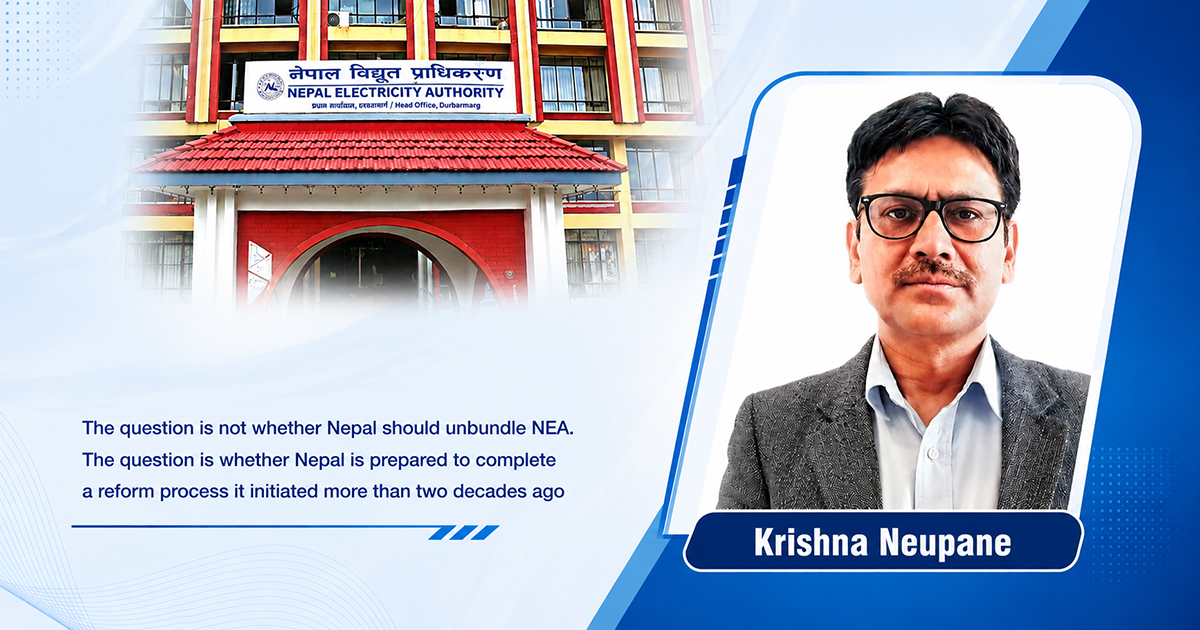
The question is not whether Nepal should unbundle NEA. The question is whether Nepal is prepared to complete a reform process it initiated more than two decades ago. Creating institutions was the first step; empowering them with authority, resources and accountability is the unfinished task.
Neupane is a hydropower engineer with a Master’s degree in Water Engineering and Management from the Asian Institute of Technology (AIT), Thailand. He has over 25 years of experience in hydropower, water resources, infrastructure development, and governance.
Conversation
Krishna Neupane
Neupane is a civil engineer and gold medalist with a Master’s degree in Water Engineering and Management from the Asian Institute of Technology (AIT), Thailand.

More News





- Nepal's First Energy Based News Portal
-
Energy Information Center Pvt. Ltd.
Hemant Marg-11, Babar Mahal, Kathmandu
- Info. Dept. Reg. No. : 254/073/74
- Telephone : +977-1-5321303
- Email : [email protected]