Energy Update



Asia-Pacific Cheers Nepal’s Climate Action
-
 Urja Khabar
- 29 October, 2026
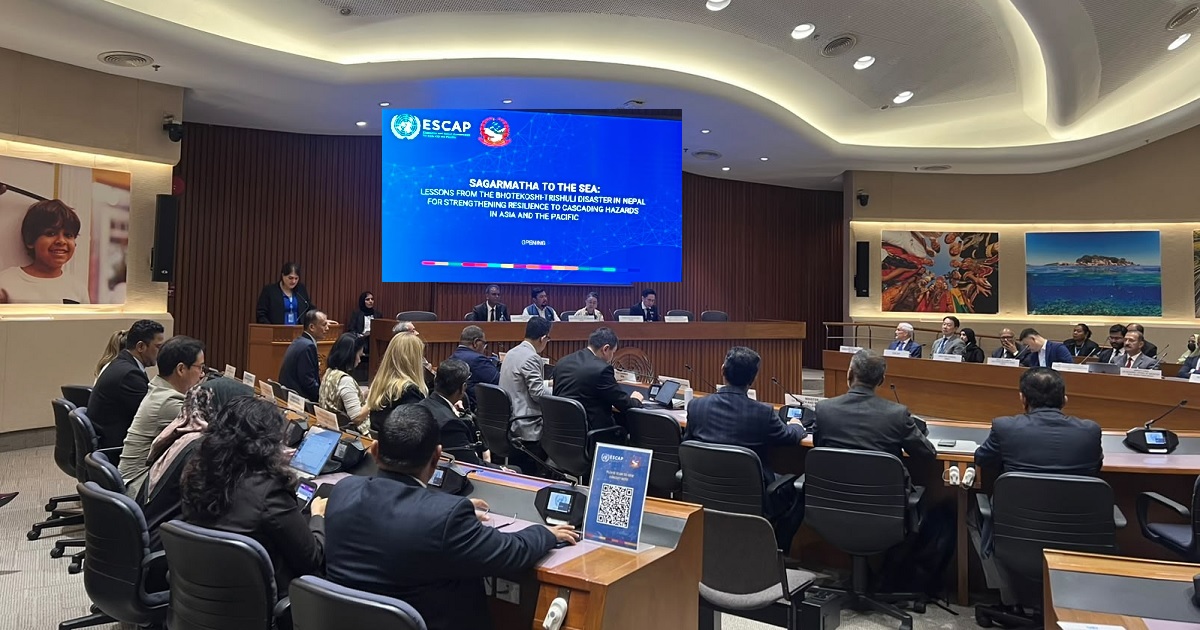
Kathmandu: Majority of the countries from the Asia-Pacific region have expressed their solidarity to support Nepal's proposal for an Asia-Pacific regional space cooperation for climate disaster preparedness.
Expressing their concerns, a total of 53 nations participating in a high-level regional dialogue organized by Nepal in Bangkok, Thailand, expressed their commitment for the integrated effort.

On the occasion of the Fifth Ministerial Conference of the United Nations Economic and Social Commission for Asia and the Pacific (UNESCAP), Nepal organized a dialogue on Thursday on the theme ‘From Everest to the Ocean: Lessons from Nepal’s Bhotekoshi-Trishuli Disaster to Prevent Chain Disasters in the Asia-Pacific Region’.
The program, jointly organized by Nepal and UNESCAP at the United Nations Conference Center in Bangkok, is attended by ministers, diplomats, scientists and disaster management experts from various countries in the Asia-Pacific region. Speaking at the program, Minister for Energy, Water Resources and Irrigation Biraj Bhakta Shrestha proposed regional space technology, satellite information access, and data exchange to combat climate change.
Nepal organized the dialogue on the sideline of UNESCAP's meet to inform the world forum about the Bhotekoshi-Trishuli disaster. In the high-level dialogue, attended by ministers from the Asia-Pacific region, Nepal shared its experience of the climate crisis and the chain of disasters it has experienced, and discussed the crisis in the Himalayan region due to global warming and climate change.
Nepal is reported to have highlighted the issue on how a severe chain of disasters in the Bhotekoshi and Trishuli river areas caused great damage to hydropower projects, road infrastructure, border mechanisms and the livelihood of local communities.
Similarly, Nepali Ambassador to Thailand Dhan Bahadur Oli and UNESCAP Executive Secretary Amida Salsiya Alisyahabana noted that regional data exchange and integrated early warning systems are indispensable to protect ecosystems from the mountains to the sea.
During the dialogue, three main topics were discussed in depth to strengthen disaster resilience. In particular, Nepal has emphasized the need to study the interconnected risks posed by climate, glaciers and geological changes in detail, to exchange emergency data, hydrological measurements and risk-related information promptly among neighboring countries in times of crisis, and to make the early warning system more efficient through the use of space technology, satellite mapping, artificial intelligence and youth-centered technology.
On behalf of Nepal, Sanjay Acharya, Member of the National Planning Commission, Dharmaraj Upreti, Chief Executive Officer of the National Disaster Risk Reduction and Management Authority, and Archana Shrestha, Director General of the Department of Hydrology and Meteorology, have given working papers and analytical presentations.
Similarly, ministers from Thailand, Bhutan, Fiji, Samoa, Sri Lanka, and Kyrgyzstan, as well as representatives from China (NDRC), India (ISRO), the World Meteorological Organization (WMO), ICIMOD, and the Asian Development Bank (ADB), have emphasized the need to prepare a regional action agenda for the resilience of the Himalayan region.
Conversation


More News







- Nepal's First Energy Based News Portal
-
Energy Information Center Pvt. Ltd.
Hemant Marg-11, Babar Mahal, Kathmandu
- Info. Dept. Reg. No. : 254/073/74
- Telephone : +977-1-5321303
- Email : [email protected]