 Urja Khabar
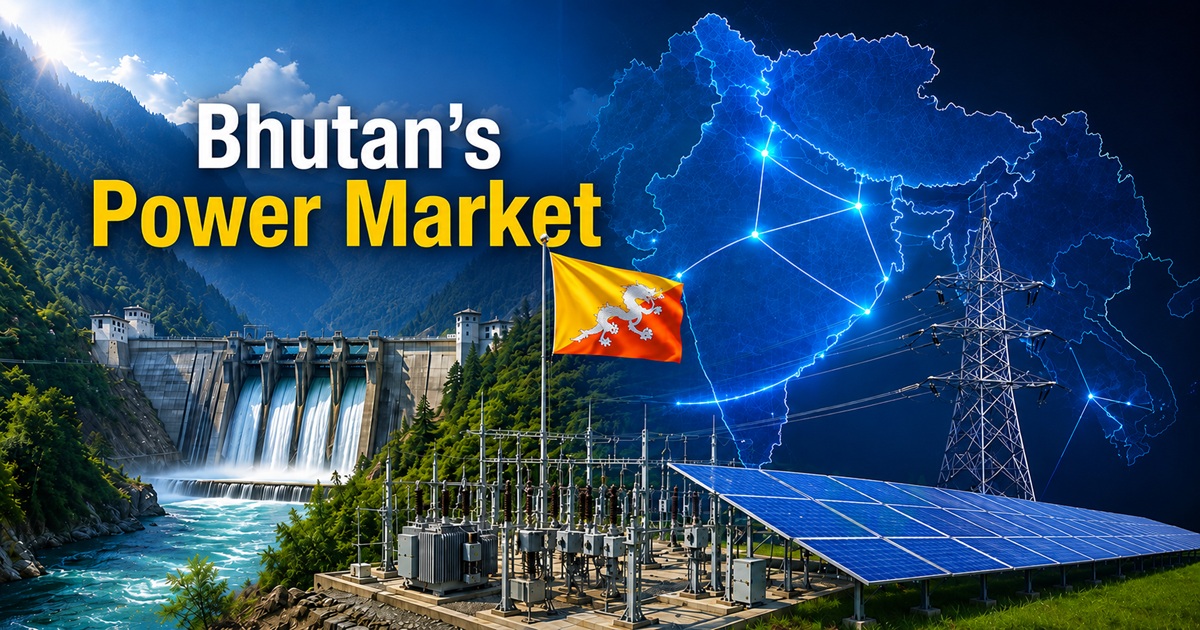
Kathmandu : Bhutan has stepped up implementing a phase wise overhaul of its electricity market, seeking to move gradually from the existing centralized, single-buyer system to a competitive hybrid market model by 2040.
The ‘Bhutan Power Market Framework,’ endorsed in June 2026 by the Department of Energy under the Ministry of Energy and Natural Resources, has attributed rising domestic electricity consumption, seasonal fluctuations in hydropower generation and the rapid development of regional electricity markets for this new initiative. This measure is expected to transition the mountainous country towards a more competitive and transparent power market while maintaining the stability of long-term power purchase agreements (PPAs).

Bhutan’s power sector is mostly based on hydropower, with an installed generation capacity of 3,576 MW. The sector currently operates under a centralized structure in which state-owned Druk Green Power Corporation (DGPC) generates electricity and supplies it to Bhutan Power Corporation (BPC), the country’s single utility responsible for transmission, distribution and retail supply.
The framework says the existing model has helped maintain affordability, system stability and near-universal electrification. However, it argues that the system has limited mechanisms for transparent price discovery, dynamic system optimization and competitive participation.
One of the major challenges is seasonal variation in hydropower output. Run-of-river projects generate electricity surpluses during the monsoon season, while generation can fall significantly during winter, when Bhutan has to rely on costly imports.
The proposed market framework is designed to address these imbalances while enabling Bhutan to capture greater economic value from its hydropower resources. It also seeks to align the country’s electricity sector with evolving regional markets, particularly in India.
The framework is built around three major components: a centralized PPA Registry, Day-Ahead and Real-Time electricity markets, and ancillary and green markets.
The centralized PPA Registry would provide a single digital repository for power purchase agreements, including information on contracted and available capacity. It would also identify tied and untied capacity and incorporate contractual restrictions into market operations.
Under the proposed Day-Ahead Market (DAM), participants would submit bids for electricity delivery on the following day in 15-minute blocks. A centralized auction would determine a uniform Market Clearing Price and establish baseline generation and demand schedules.
A complementary Real-Time Market (RTM) would allow participants to adjust closer to delivery in response to changes in forecasts, generation and system conditions.
The framework also proposes an ancillary services market covering services such as frequency regulation, operating reserves and ramping support. This is intended to monetize the flexibility of Bhutan’s hydropower assets and strengthen grid reliability.
A green market would allow environmental attributes, including Renewable Energy Certificates and carbon credits, to be certified and traded.
The transition would take place through a hybrid model. Initially, the existing regulated system would remain in place. In the second stage, limited untied generation capacity and marginal demand would be exposed to market-based trading. The DGPC and future independent power producers would act as sellers, while BPC would remain the anchor buyer.
Energy-intensive consumers could participate directly or indirectly through BPC. Designated traders would also be allowed to participate, particularly in cross-border electricity trade.
As the market matures, the framework envisages expanding participation to additional traders, direct consumers and cross-border entities.
The reform will be implemented in three phases. The Foundation phase runs from 2025 to 2027 and focuses on policy, regulation, institutional arrangements and development of the digital market platform, including the PPA Registry. Pilot and shadow-market operations are also planned.
The Domestic Market Development phase, covering 2027-2029, would launch regular Day-Ahead Market operations and introduce the Real-Time Market, while gradually increasing participation and developing ancillary and green markets.
The final phase, from 2030 to 2040, would focus on expansion and regional integration, including cross-border participation, alignment with regional market frameworks and eventual progression towards market coupling.
According to the framework, the reform could improve export returns, strengthen energy security, attract investment in storage and flexible generation, and optimize domestic use of hydropower.
The framework ultimately seeks to position Bhutan as a key regional clean-energy player by using its hydropower resources not only for conventional electricity generation but also for balancing, reserve and other services in an increasingly integrated regional electricity market.