 Urja Khabar
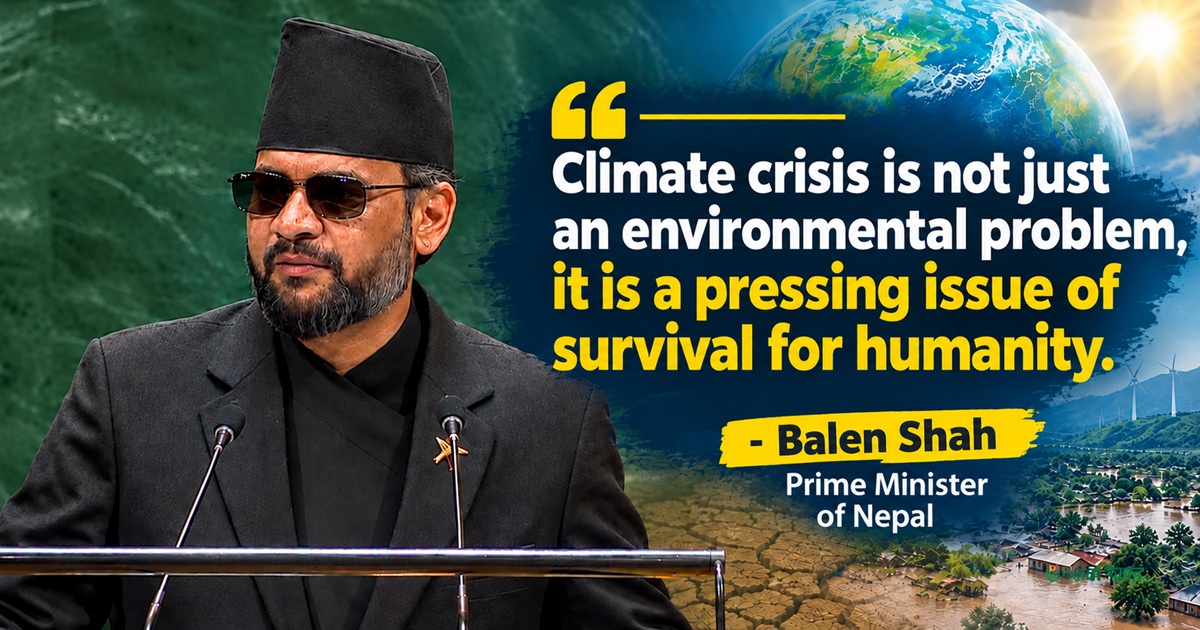
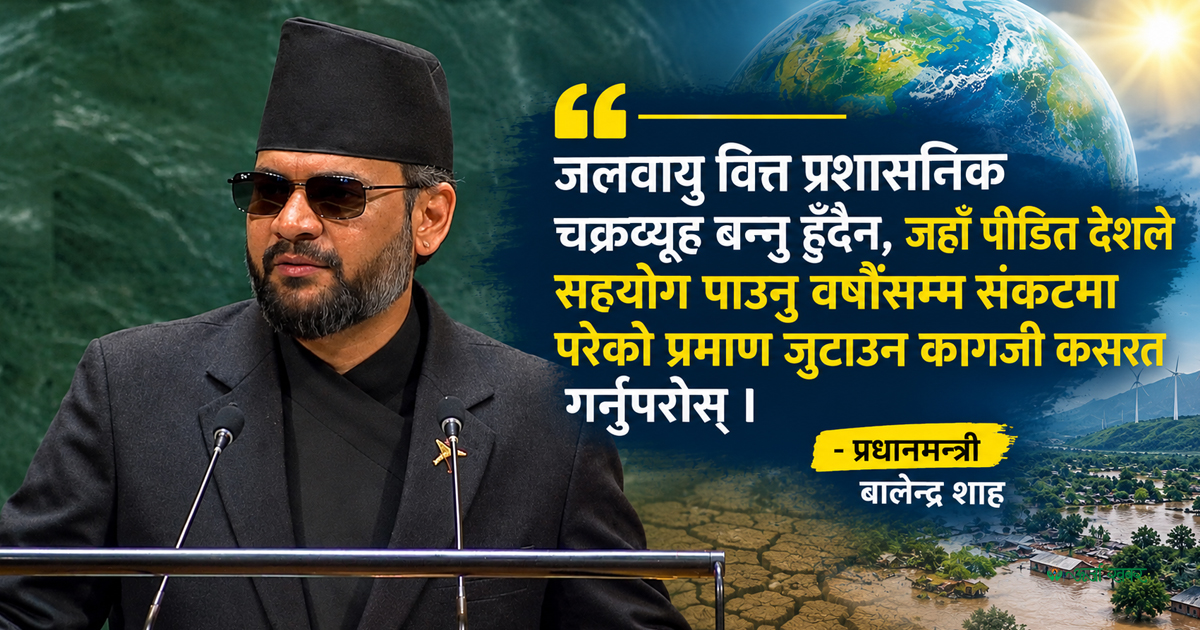
Kathmandu: Prime Minister Balen Shah has called for cooperation from neighboring countries India and China to establish a Himalayan Climate Resilience Mechanism to address the growing challenge of climate change that Nepal has been facing at present.
Addressing the 81st session of the United Nations General Assembly in New York on Thursday, Shah said the mechanism should allow the three countries to share satellite data and technical expertise, monitor dangerous glacial lakes, strengthen early-warning systems and coordinate assistance when disasters occur. “Let the Himalayas become a laboratory of international cooperation, rather than a frontier of fragmented information,” Shah said.

Shah placed Nepal’s recent Bhotekoshi-Trishuli floods at the centre of his speech, describing the disaster as a warning to the international community about the growing risks facing the Himalayas. He called for greater international support for countries facing the consequences of climate change, saying Nepal is paying a “colossal price” for a crisis it did little to create.
Shah informed the international forum that the recent disaster in Rasuwa killed at least 1,400 people and left more than 6,000 missing, while preliminary assessments put Nepal’s physical recovery needs at around 10 percent of its GDP. “The floods swept away bridges, roads, schools, homes and livelihoods and interrupted Nepal’s progress towards the Sustainable Development Goals.”
“Climate change does not recognize borders,” Shah said, pointing to the effects of melting glaciers, unstable mountain slopes, floods and landslides across Nepal, China and India. “I come before you from Nepal — a distant country in the Himalayas — carrying a close warning for humanity,” Shah said.
Comparing Climate Disasters to War
Shah's address includes issue of war while he interrelated with climate disasters. He mentioned that due to the consequences of the recent climate crisis Nepal has faced, the residents need to 'endure the fate of a war they did not start'.
Furthermore, Shah indicated that countries like Nepal are suffering a double blow from the effects of the climate crisis and war, saying, 'Nepal is bearing the brunt of a climate it did not cause and is also suffering the effects of a war it did not start.'
Similarly, he drew attention to another paradox in world order. According to him, while the world has built efficient systems for war, it has created weak and chaotic systems for food security.
Shah also questioned the inequality between economic activities and human needs. He stated that countries ready to pay should be able to buy necessary goods and expressed the view that in a world where weapons can be delivered anywhere in 72 hours, there can be no excuse for depriving farmers of their means of livelihood.
'Climate Justice' before Relief
The core message that Shah delivered international community was the inequality between the impact of the climate crisis and responsibility for it. He highlighted on the world stage that although Nepal has low emissions, it is experiencing rapid temperature increases in the Himalayan region, glacial risks, floods, and other disaster impacts.
Climate finance, loss and damage, and international cooperation for Himalayan countries have been put forward as major priorities for Nepal in this year's General Assembly.
Prime Minister Shah urged that Nepal should not just be given relief after disasters, but should be provided with the necessary resources, technology, and international cooperation to build a future safe from climate risks. He also urged that the crisis in the Himalayas should be considered a global challenge, not just a problem for Nepal or South Asia.
“We must also understand why this disaster matters beyond Nepal's borders. Nepal’s share of global greenhouse gas emissions is less than 0.1 percent. We did not create this crisis, yet we are paying a terrible price.”
Shah underlined that glaciers of the Himalayan country are melting and receding. The mountain slopes are becoming unstable, and the flow patterns of rivers are becoming unpredictable. Every major disaster carries the escalating risk of instantly wiping out years of development efforts. “For Nepal, climate-induced disasters represent not merely a humanitarian crisis but a crisis of development itself; they destroy our roads, bridges, schools, homes, farmlands, and livelihoods.”
Climate change impacts devastate the clean energy infrastructure essential for building our future, while they force a poor nation to incur further debt to pay for damages resulting from a crisis it did not cause. “We are not here to cast blame on any specific country or continent, nor are we here to turn climate change into another geopolitical battleground. Rather, we are here to urge everyone to recommit shared responsibility and solidarity,” Shah expressed.
Climate Justice and Global Inequality Interlinked
Nepal’s Prime Minister also broadened his argument to the wider international order, saying the UN was founded on the principles of sovereignty, international law and human dignity.
He called for a fairer global economic order and said climate justice was not simply about financial assistance. “It is about distributive justice — who bears the costs,” he said. “It is about procedural justice — who has a voice.”
Shah said the international system should also consider whether the interests of mountain communities, small island states, landlocked and least-developed countries, and future generations were being given equal weight.
Six Words for Climate Action
Shah framed Nepal’s immediate demands around six words. “Relief. Rehabilitation. Reconstruction,” he said. “And also: Responsibility. Reparation. Resilience.”
The first three, he said, were needed after a disaster, while the latter three were necessary to ensure that climate disasters did not become a permanent condition for vulnerable countries.
He said Nepal had already taken steps to strengthen its resilience, including restoring forests, expanding hydropower, promoting electric mobility and strengthening climate adaptation at the local level. He said Nepal could not build resilience alone.
“Remarkable for a least developed country, Nepal is already playing a global role exceeding its ecological share,” Shah said.